 For Client Support:


 Blog Details
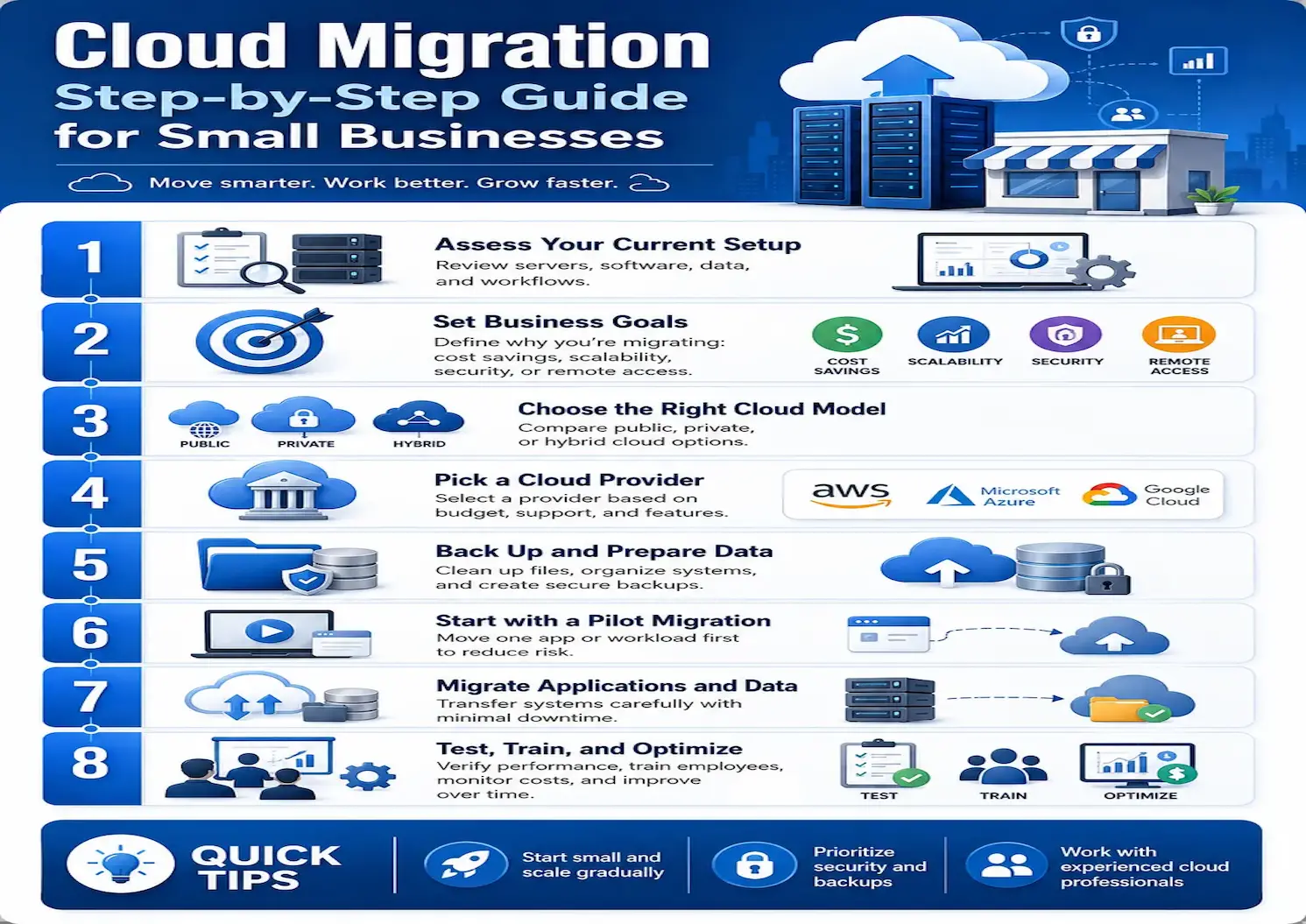

Businesses evaluating cloud migration checklist for small businesses need practical guidance that accounts for security, cost, maintainability, and customer experience. This guide from Cloud Technology Computing explains the decisions and implementation checks that matter most.
Inventory Your Existing Systems
List domains, DNS records, website files, databases, cron jobs, email dependencies, API integrations, certificates, storage, and third-party services. Identify the business owner for each system and record which functions are critical.
Choose a Migration Strategy
Decide whether to rehost, replatform, or rebuild each component. A simple website may need only a hosting move, while an aging application may benefit from updated dependencies and better deployment practices.
Back Up and Test Recovery
Create verified backups of databases, application files, and configuration. A backup is not a recovery plan until it has been restored successfully in a test environment.
Prepare Security and Networking
Define access controls, firewall rules, HTTPS certificates, secrets management, logging, and monitoring. Confirm how the new environment will connect to email, payments, analytics, and other integrations.
Run a Prelaunch Test
Check navigation, forms, checkout flows, search indexing, canonical tags, redirects, structured data, responsive design, and images. Compare performance before and after migration using consistent measurement conditions.
Cut Over and Monitor
Schedule DNS changes during a manageable period, monitor error logs and uptime, and keep a rollback plan. Review billing and traffic after launch to catch unexpected infrastructure costs.
Next Steps
Document your current systems, prioritize the highest-impact improvements, and test changes before production deployment. For help planning cloud infrastructure, custom software, or website optimization, contact Cloud Technology Computing.

0 Comments